Actions
The action manager. Something was found; someone has to fix it.
What it is
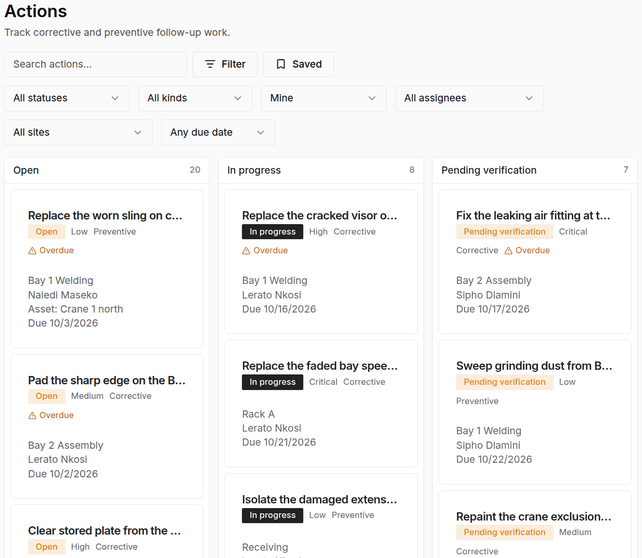
Action management is the process of capturing, tracking, resolving, and verifying actions. It bridges the gap between identifying a problem and making sure it is permanently fixed. An action is a piece of work with a title, an owner, a due date, a priority, and a status. It can be corrective (removing the root cause of an existing problem) or preventive (removing the root cause of a potential problem). Actions are how findings become accountable work.
Where actions come from
- A flagged answer on an inspection
- An observation
- An asset, when the work belongs to a piece of equipment
- An investigation, often one task per cause or contributing factor
- A risk assessment, when the remaining risk is still too high
- A schedule, when it is set to raise a task each time work is due
- The actions list itself, for a standalone task
From open to completed
The usual path is open, then in progress, then pending verification, then completed. Closing from pending verification normally needs a completed follow-up inspection, or a person with permission to verify.
What an action can carry
- More than one assignee
- A type and labels defined by the organisation
- A repeat rule and a note thread
- An attached template, so the assignee starts a follow-up inspection from the task
- An automated reminder on the due date
Lists can be filtered, exported, updated in bulk, and viewed as cards, a table, or a kanban board.
- A flagged answer on an inspection
- An observation
- An asset, when the work belongs to a piece of equipment
- An investigation, often one task per cause or contributing factor
- A risk assessment, when the remaining risk is still too high
- A schedule, when it is set to raise a task each time work is due
- The actions list itself, for a standalone task
Start with templates, inspections, and actions.
Free to start. No card needed. 14-day Pro trial when you create an organisation.